Virtual Reality provides students with a virtual environment in a computer-generated setting, where users can interact through an interface in real time using the user’s actions (Innocenti, 2007; Tussyadiah, Wang, Jung & Dieck, 2018). To illustrate a certain level of VR immersion, the CoSpaces application was used in tandem with Google Street View during this week’s tutorial so that 3D virtual cues were created in a ‘real-world environment’.
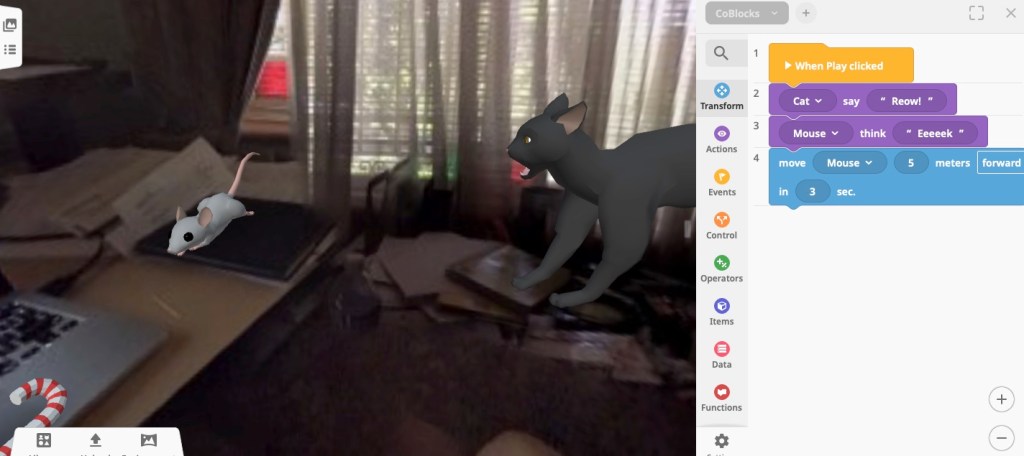
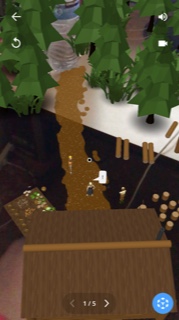
This emerging tech can be provided through either desktop VR or mobile VR, making it accessible for all schools/students from various demographics to customise their own virtual world and create stories. Dede (2009) believes that mobile VR does provide a more immersive experience, so if this option is viable in your classrooms then Number Hunt (Mathematics) or Becoming Homeless (stimulus for writing or social sciences) are suitable selections/types of mobile VR apps that are engaging and provide hands-free access (Bambury, 2020).
Tussyadia, Wang, Jung & Dieck (2018) suggest that tethered devices allow for greater student immersion in the virtual world. However, recommending untethered headsets allows for all schools and most students to access VR tech, albeit through their smartphone or desktop to effectively incorporate it into educational settings.
The advantage of CoSpaces is that it can be utilised in a number of subject domains, such as producing a creative writing piece into a virtual world story in English, or in situ contextual information for Ancient Rome in History. Pedagogically, task design can be set up for autonomous work and utilising first-person view (as in CoSpaces) or through group constructive learning where communication and in situ guidance can be provided from fellow students instead of instruction from the teacher when immersing one’s self in the virtual world (Bower & Sturman, 2015).
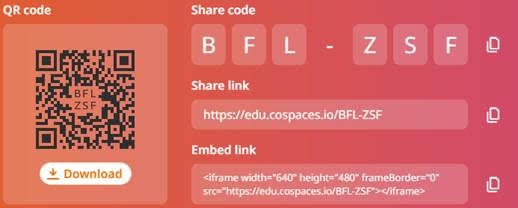
https://edu.cospaces.io/BFL-ZSF
Sural (2018) notes the Construct3D enables students to understand difficult concepts through AR. Similarly, Mikropoulos & Natsis (2011) and Dede (2009) discusses how VR provides learning through multiple perspectives and for certain concepts/ideas such as physics of movements. This provides abstract/symbolic insights when students distance themselves from the context of the lesson (in light of the CoSpaces app).
Bambury, S. (2020, March 30). The Top 10 Educational VR Apps of 2018. Retrieved from https://www.vrfocus.com/2018/12/the-top-10-educational-vr-apps-of-2018/
Bower, M. & Sturman, D. (2015). What are the educational affordances of wearable technologies?. Computers and Education, 88, 343-353.
Dede, C. (2009). Immersive Interfaces for Engagement and Learning. Science, 323, 66-69.
Innocenti, A. (2017). Virtual reality experiments in economics. Journal of Behavioral and Experimental Economics, 69, 71–77.
Mikropoulos, T. & Natsis, A. (2011). Educational Virtual Environments: A Ten-Year Review of Empirical Research (1999-2009). Computers and Education, 56, 769-780.
Sural, I. (2018). Augmented Reality Experience: Initial Perceptions of Higher Education Students. International Journal of Education, 11(4), 565-576.
Tussyadiah, I.P., Wang, D., Jung, T.H. & Dieck, M. C. (2018). Virtual reality, presence, and attitude change: Empirical evidence from Tourism. Tourism Management, 66, 140-154
 EDUC3620 Digital Creativity and Learning - Peter R's blog